
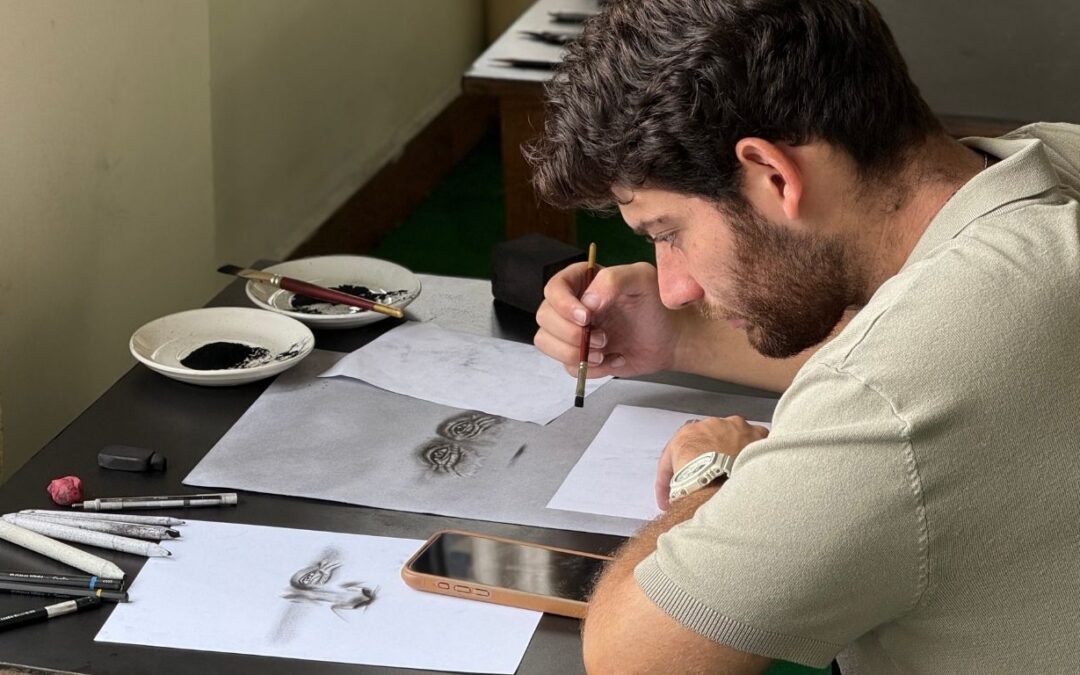
When viewing charcoal sketches and portraits, it is natural to wonder at the process of the artist. One thinks of figures bent over the canvas, lost in thought, with charcoal-stained fingers, brushes in hand. Rarely do we consider the artist’s eye that saw the portrait contained in the blank canvas in the first place. Or how it guided the thousands of choices made at every stage of creation. Even with all the technique and muscle memory, the hand ultimately follows what the eye sees. Truly, if creativity begins within us and ends on the canvas, it is the eye that is its conduit: it is where all sketching begins.
For that matter, it is important for anyone learning charcoal portrait sketching to not only train their hands but also their eyes. But what does it mean to train one’s eyes?
A window to the soul
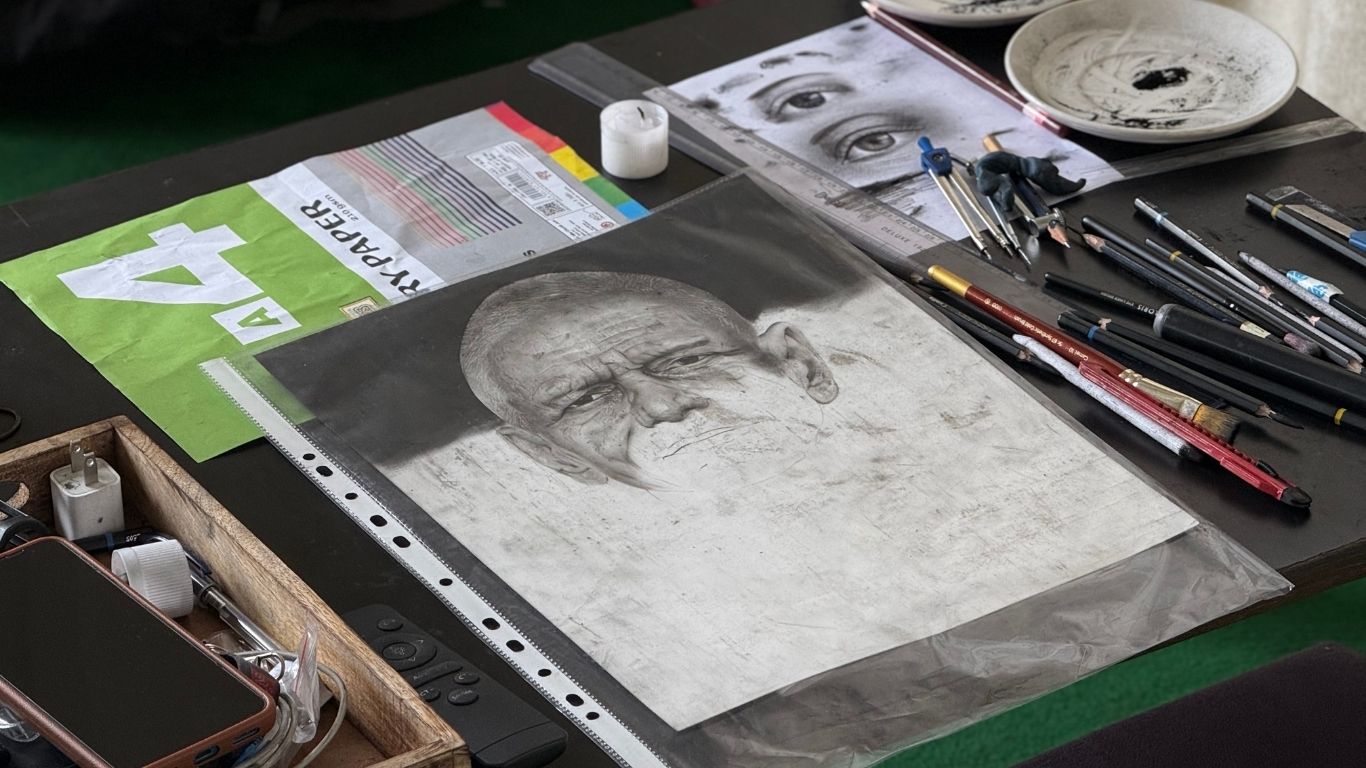
We are visual creatures primarily. About half our brain is devoted to it because visual information is important to us. It is also the highest resolution of information available to us. Where we look and what we attend to in our field of vision is a marker of what we value, consciously or unconsciously, of what’s important to us. A window to our souls are our eyes. It is no surprise, then, that focusing on something has become synonymous with looking at it first, sometimes for hours at a time. But sustained focus isn’t the answer either, especially when doing charcoal portrait sketching.
Improve your charcoal sketches by taking breaks
Like the muscles in our arms and legs, the (ciliary) muscles in our eyes work best when they’re allowed to relax from time to time. In fact, it is recommended not to focus for more than half an hour without taking a short break. This keeps the eyes and the mind from tiring out early, and you are able to reach deeper levels of focus.
Breaks help in another way: When we focus, the eyes map what we see in our mind. But if we remain in that state for too long, we are at the risk of becoming too short-sighted. We’re too close to the portrait, too focused on the details. The frame of our mind gets narrower and we are liable to miss the forest for the trees. Taking a break every so often allows the conscious mind to loosen its grip on what the eyes see. While you’re out looking at clouds or sipping tea, the problems slip under the surface to the subconscious mind where they are better processed.

When we return, our mind re-engages with the sketch, reframes it, and we gain perspective once again. We return thus with ‘new eyes’, better equipped to dive into the sketch again. Alternating between deep focus and relaxing breaks catalyses the learning process, and can turn anyone into a charcoal sketch artist.
Also Read: Why 6 and 9 Day Charcoal Portrait Courses Are Ideal for Building a Strong Foundation
How the Science of Sketching methodology helps see more
Making charcoal portraits forces us to see more than what we’re used to seeing. When talking to others, most people tend to focus on the eyes and the mouth and miss other features of the face, like the noses and the ears, or the chin and the brow. But when you sketch, you have to focus on every aspect of the subject’s face. The ear is no less important than the eyes, nor the nose from the mouth. Eventually, we bring that same level of attention to other things.
Visual arts like charcoal portrait sketching consistently help us break old patterns. As the eye begins to pick out things that it previously glossed over, we slowly gain a new way of looking at the world. But this transformation doesn’t come automatically. One needs to engage with charcoal sketching again and again without fear, and become inured to making mistakes.
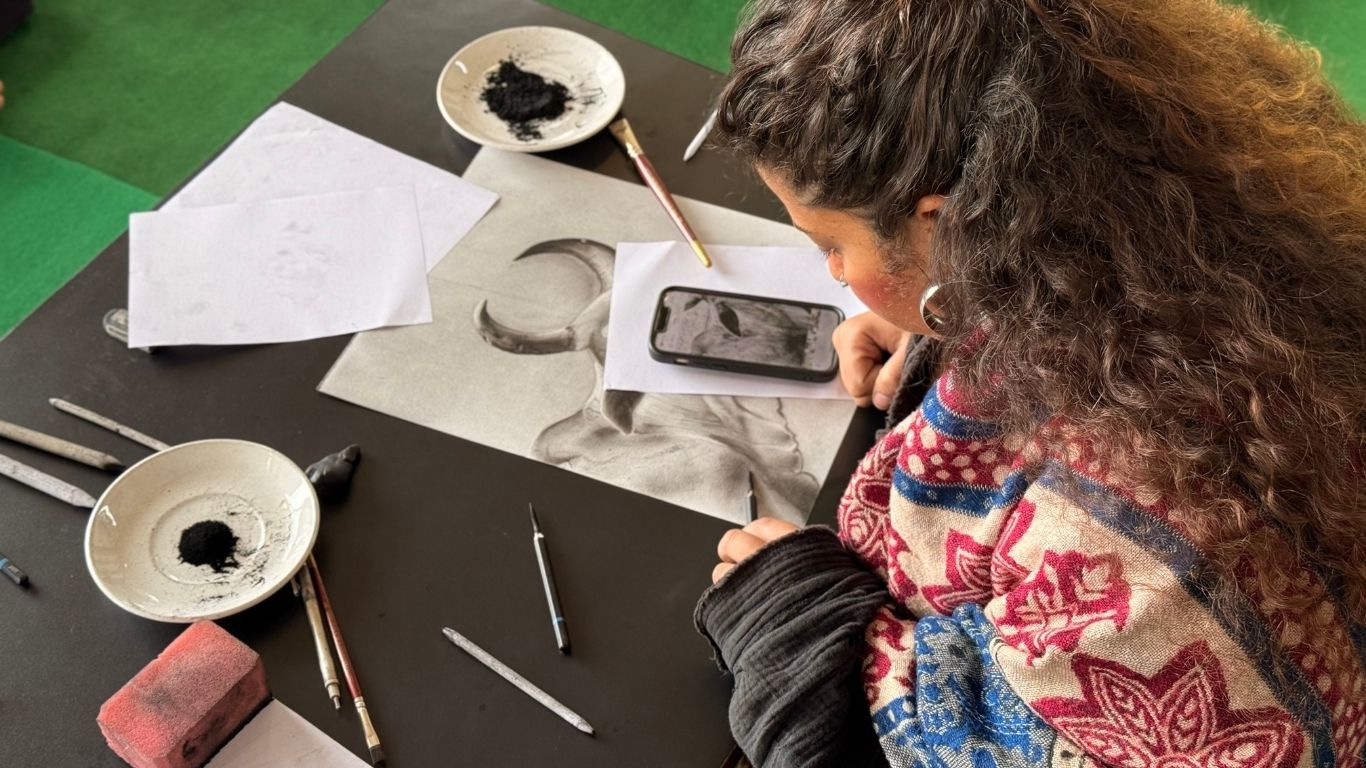
One’s eyes remain the guiding instrument throughout one’s charcoal sketching journey. If you are unafraid of making mistakes, if you miss nothing, and if you know the techniques to train your eye, your inner eye will begin to show you visions of charcoal portraits clearly and palpably, as though they were jumping out of the canvas.