Every creative act bears the mark of its creator. Like a fingerprint that is uniquely one’s own, or a face that is naturally like no other, creativity is a natural part of our being. Yet, we lose over time that spirit of play and wonder that animated us in our younger years. Habits take over, the instinct retreats, and we hesitate. Without evidence, we come to believe that it is us who is not creative, that creativity must be some mystery reserved for the geniuses or a prerogative of the artists. Nothing could be further from the truth. Nor is it mystical speculation to think that every one of us is innately creative. If children have the creative instinct, so do adults. It can no more disappear than our need to eat, play, or sleep. All it takes to tease it out again is some calm, quiet, and a guiding hand.
In an age of distraction where a thousand things vie for our attention, something as seemingly simple as charcoal sketching can seem nothing short of meditative art. But charcoal sketching – a practice that is many thousand years old – is a highly sophisticated fine art, not despite its simplicity, but because of it. Without the need for any fancy equipment, charcoal drawing strips away all unnecessary elements, until all that remains is the charcoal pencil, the canvas, and the object. But it’s not all a solitary act. Sketching classes in Dharamkot attract begginers and returning artists alike who wish to reconnect with their innate creativity and bring it to their everyday lives, their work, hobbies, and relationships. But how is this done?
Learning techniques fundamental to art with charcoal portrait workshops
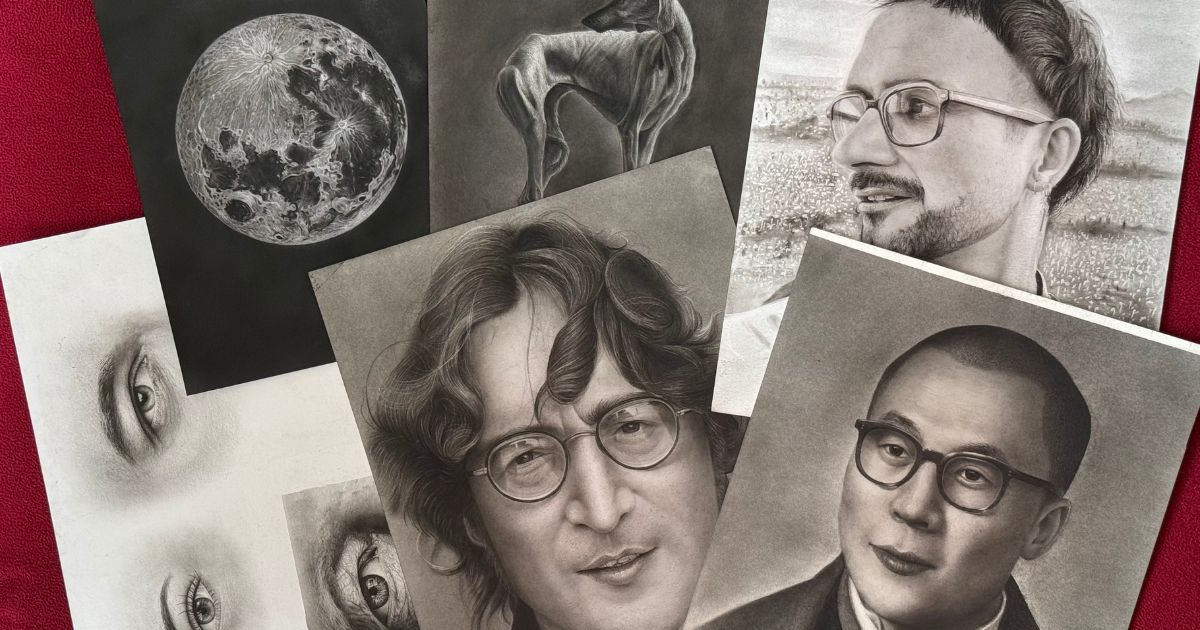
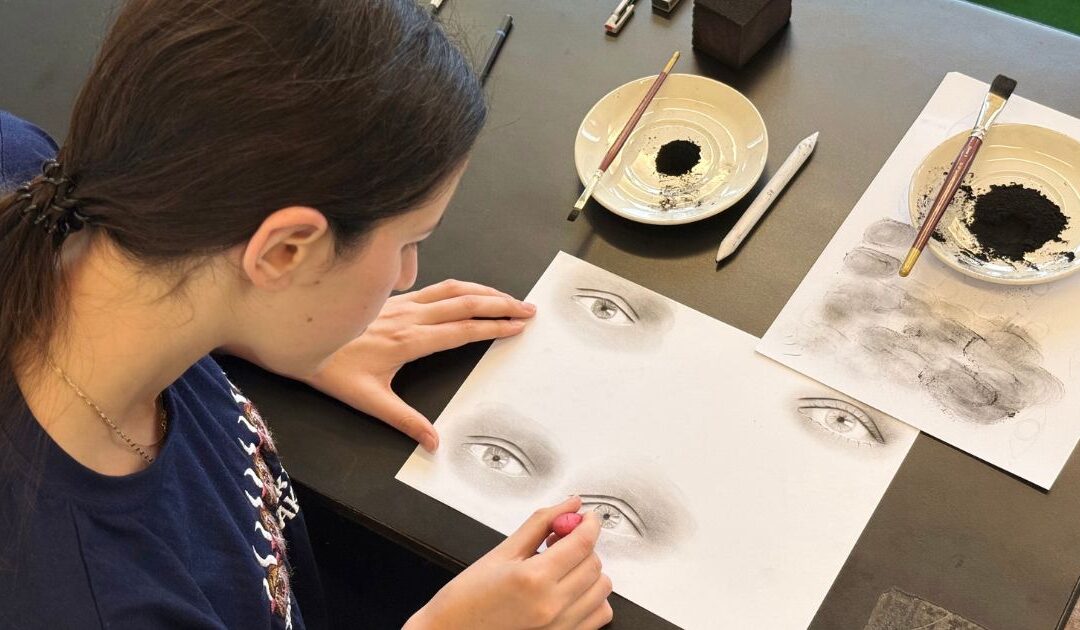
There’s no doubt that charcoal portraits are resplendently beautiful. But to the uninitiated, learning how to draw with charcoal can seem daunting. The fact of the matter is that anyone – yes, anyone! – can learn charcoal sketching. It helps to break down its complexity into manageable chunks to see how one can learn the techniques that are fundamental to not just the art of sketching charcoal portrait but fundamental to all art.
In the process of learning such techniques as tonal variations, contrast and layering, capturing proportions, and refining lines for softness and clarity, one automatically slows down, and the process itself becomes the reward. While one learns to handle the tools, one also comes to observe acutely and focus for long periods. For charcoal sketching is a subtle art, and requires close attention to form, structure, and proportion. Each stroke and highlight is made in service of one’s subject, whatever it may be, and the layers that make it up. Light and shadow, shape and shade, all blend with layers upon layers of work to create a realistic sketch. Patience is not a pre-requisite to learn how to draw with charcoal. Instead, one learns to be patient through charcoal sketching.
While you immerse yourself in the techniques of charcoal art, something magical begins to take shape within you. The brain begins to rewire eye-to-hand coordination, new neural pathways are formed, and one’s powers of concentration and focus get elevated. At first the changes are subtle. But slowly, with enough repetition, all that you learn begins to percolate into the subconscious. Your improved observation skills soon begin to manifest and the world appears in a new light. Suddenly, the faces seem more vivid, their lines and contours become prominent. But it is not the world that’s changed; it is you that’s learning a new way of seeing. In essence, your perspective starts to shift and your mind opens once again to the wonders of the world.
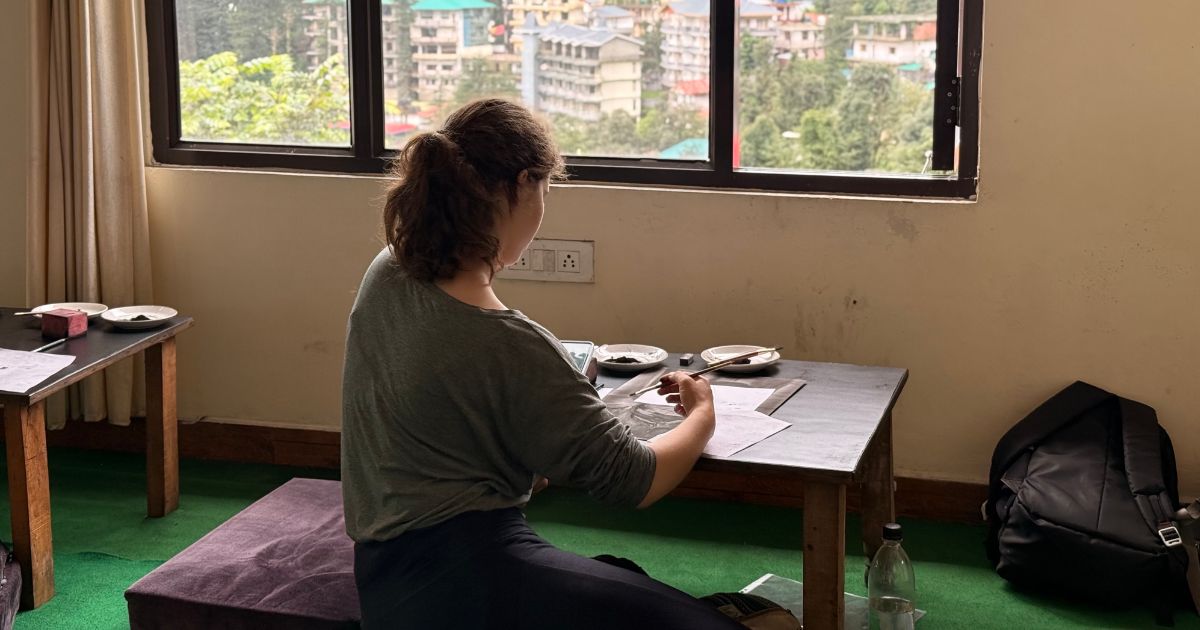
These sketching classes in Dharamkot are in every sense the art retreat that so many of us need to get in touch with ourselves again. It is mindfulness through art and drawing, immersed in an environment of learning and peaceful gratitude, working to the sounds and rhythms of nature at the foot of the Himalayas. Yet, it is more than a course in charcoal sketching alone. While helping you sharpen your technical skills, it also enables a deep development of your inner creative self.
The 3 phases of creative work
For most of us, creative acts can seem a little mysterious. But it’s a phenomenon that has been well documented, with repeatable steps that consistently produce results. To demystify this process, it’s worth going over what it looks like to do creative work. Broadly speaking, any creative work can be divided into three phases: Gathering, Executing, and Refining.
Before embarking on a creative project, we research and Gather ideas. This is the time to consume, to watch movies, take nature hikes, look at other charcoal portraits, talk to people, listen to music – inspiration can come from anywhere! Then jot down ideas, make mind maps, outline sketches. At this stage you’re experimenting until you decide on your subject. What is it that you’re going to do? What will you sketch, what do you want to bring out? It’s also the time to get everything you’ll need for your art. Truly, it’s one of the most energetic phases of the process. But don’t let all the positive energy fool you – you’ve only just begun.
Next, it’s time to Execute. This is the time when you physically engage with the work. Writers call their first draft ‘vomit’ drafts, because they don’t worry about the exact words and sentence structure at this phase. The idea is to get it out and have something to work with. Because it’s a given that almost every work of art will go through several cycles, the fear of not getting it ‘right’ the first time shouldn’t keep you from starting. Put the critic in your head on mute and just begin. Put down whatever you can. No one’s watching.
The last phase is where you Refine. This is when you take what you already have and put it under the microscope. Consider what you like and what you don’t. Isolate what needs improvement and work on it. Through repetitions and multiple iterations, you’ll slowly see it come close to your original vision. But if your vision changes and you find yourself leaning in a different direction, go ahead. Often we need to go through it to know what we actually want to make.
The three phases are not strictly linear. In real life, it is almost always circular, and you are encouraged to repeat the steps as many times as you feel necessary.
Elevating Creativity with Charcoal Sketching Workshops
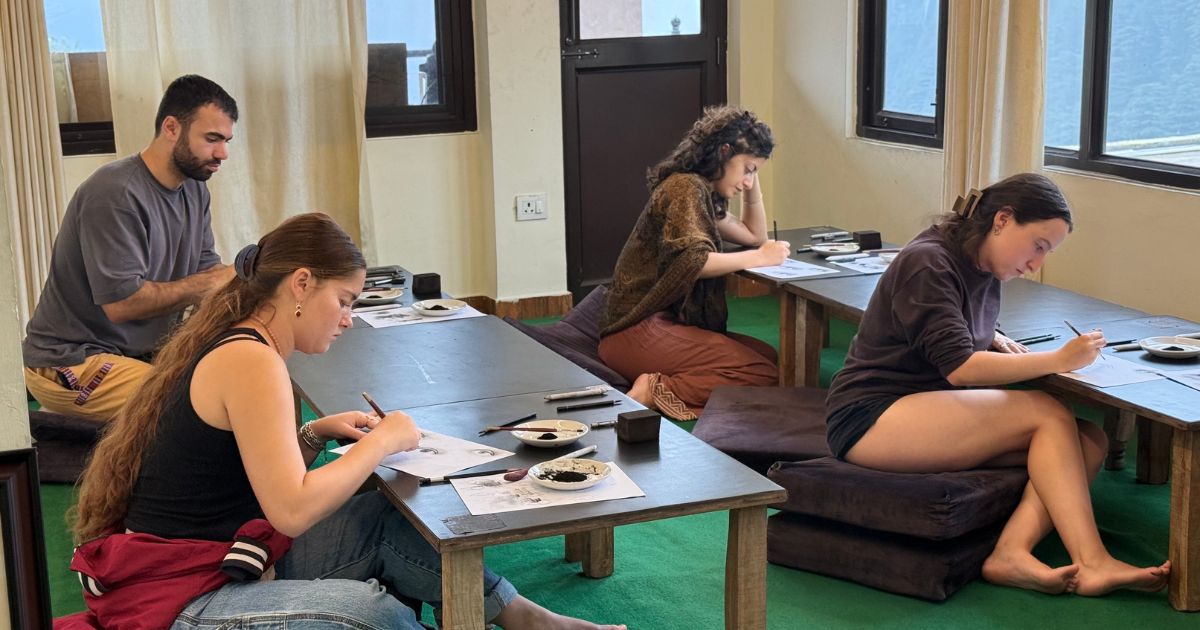
It’s not hard to see how a course in charcoal sketching can elevate creativity. Through the experience of attending charcoal portrait workshops, you come to learn that charcoal is only the medium. The creativity lies within yourself. It may end up on the canvas or on a page but its source ultimately is you. The technical skills can be learned but the focus and attention you give to your sketches is what ultimately trains your mind to see things afresh. Creativity, after all, is about perceiving the same information in novel ways.
Being a fine art, charcoal sketching elevates our creativity by bringing the body and its natural instinct into the work. One needs a good posture for long periods of focus, and the fine motor skills that develop through charcoal sketching remain with us for life. For lateral thinking, which we associate with creativity, is not just a mental activity. There’s arguably more intelligence in our body than our brain.
You can even speed up your learning with a simple hack – Focus deeply for a set period, then take a break. Repeat until you feel your focus diminishing. Eat well and hydrate, have a good night’s rest, and then start again the next day. This helps the brain pick up new skills faster without getting bogged down. Alternating between deep focus and rest is also how all creative works are done. Be it in painting or music, writing or sculpture, the ‘aha!’ moment that follows a period of gestation is well documented, even if it’s not well understood. But since it is repeatable, it is an essential part of creative work. Ultimately, it is what artists mean when they say ‘trust in the process’. For your brain, body, and the subconscious are designed to take care of everything else, and to feed ideas to your conscious mind. You only need to be awake and ready with your newly learned skills to catch them.
Finally, and perhaps the most important reason why charcoal sketching workshops enhance creativity is it gives one a sense of belief in oneself. There’s no shortage of people who wish they could sketch but have come to believe that they can’t. So they never try. But when you have a teacher who guides you, who shows you the ropes, and who journeys with you every step of the way, one cannot help but learn and rediscover the deep joy in learning.
Step by step, the vistas unfold, the horizons take shape, and the faces in the portraits come alive – all under your hand. Looking back, one can hardly believe oneself the creator of charcoal portraits – something that is mentioned time and again by those who join the charcoal portrait workshops. Of everything that one learns through charcoal sketching classes, belief in one’s own potential is the most rewarding takeaway. For if we can learn to sketch charcoal portraits in a few days, what else is possible? This is the final step away from fear and towards self-belief, that all important ingredient that makes creative works possible, and is the predictor of long-term creativity.
So if you too feel stuck in your old ways, or want to get in touch with your creative self again, consider a charcoal sketching course. A new perspective awaits, because sometimes, all you need is to see!
Trackbacks/Pingbacks